AI adoption is accelerating, but building technology that businesses can genuinely rely on requires more than impressive demonstrations and powerful tools. It demands strong engineering foundations, human judgment and the right talent to turn experimentation into reliable, real-world solutions.
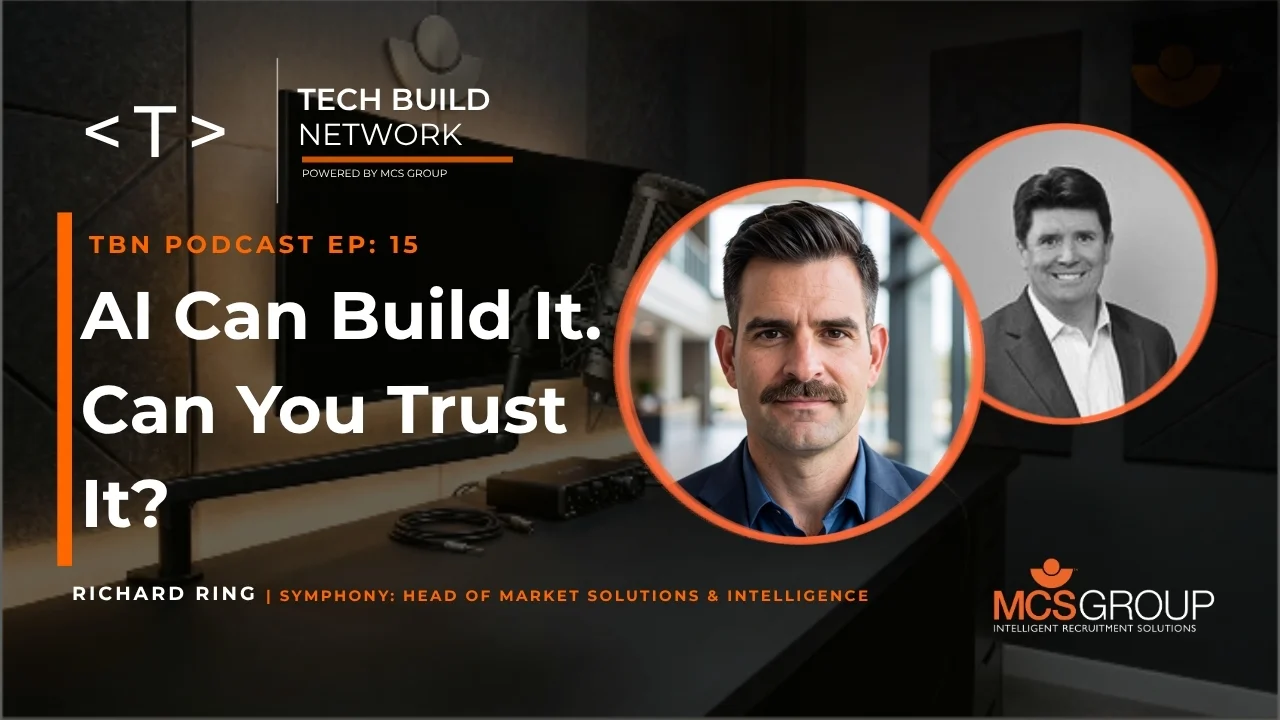
In Episode 15 of The Tech Build Network Podcast, Gary Hanley, Senior Vice President at MCS Group US, speaks with Richard Ring, MBA, from Symphony about the realities of AI adoption in financial services.
From moving beyond prototypes to navigating legacy systems and developing engineering talent, their conversation offers practical insights for technology leaders across Boston, New England and beyond.
Moving Beyond AI Prototypes to Production-Ready Systems
Building an impressive AI demonstration is relatively straightforward. Making that technology reliable within a complex business environment is a different challenge.
Symphony is a global AI-powered communication and technology company, providing secure messaging, voice, directory and analytics solutions to more than 1,400 institutions. With a strong focus on financial services, Symphony helps organizations improve collaboration, strengthen data security and navigate complex regulatory requirements.
Operating in an environment where security, compliance and reliability are critical, Symphony understands the challenges of moving AI from experimentation into production.
Richard explains that while AI-powered chatbots are now commonplace, the real challenge is introducing reliable execution into systems powered by inherently unpredictable language models.
In highly regulated environments, where sensitive information and significant financial transactions are involved, businesses cannot afford to overlook these safeguards.
"We look at human in the loop as a feature. It's not a crutch." - Richard Ring
Rather than pursuing complete automation immediately, Symphony has focused on using AI to synthesize information from multiple systems and present recommendations for human approval.
This approach allows teams to benefit from AI-driven efficiency while maintaining the oversight necessary to build trust.
Choosing AI Use Cases That Deliver Real Value
Like many organizations exploring AI implementation, Symphony's early adoption journey involved considerable experimentation.
Richard describes an initial period of internal projects and attempts to explore multiple AI capabilities before the team refined its approach.
The focus shifted toward identifying tasks where gathering and interpreting information was time-consuming, but the final decision could be made relatively quickly by a person.
Examples include summarizing conversations, reviewing CRM information and bringing together data from different business systems.
By allowing AI to handle much of this information synthesis, teams can spend more time making informed decisions.
The lesson for businesses investing in AI is to prioritize practical use cases that solve genuine operational challenges rather than adopting technology simply because it's available.
Why AI Is Changing What Engineering Teams Need
One of the most significant themes of the conversation is how AI adoption is reshaping engineering roles and hiring priorities.
Gary asks Richard how Symphony decides which capabilities to develop internally and which to recruit externally as its AI strategy evolves.
Richard explains that technical proficiency remains important, but the ability to think across entire systems is becoming increasingly valuable.
Engineers are moving beyond individual coding tasks toward overseeing architecture, validating AI-generated outputs and maintaining quality.
He describes this evolution as a shift toward becoming "more orchestration quality gatekeepers."
For employers hiring engineering talent across Boston and New England, this highlights the importance of assessing more than programming languages or familiarity with AI tools.
Richard identifies two qualities that will help define strong engineering hires:
"That curiosity and the big picture thinking." - Richard Ring
Adaptability also matters. As AI tools evolve, engineers must be prepared to continuously learn, challenge existing approaches and develop new capabilities.
Engineering Judgment: The Difference Between a Demo and a Reliable Solution
When Gary asks how AI adoption has influenced Symphony's recruitment approach, Richard highlights a challenge facing engineering hiring managers.
"Who's a brilliant demo maker and who's brilliant at production engineering?" - Richard Ring
Candidates may be able to build impressive AI prototypes quickly, but that doesn't necessarily mean they understand how to deliver resilient, production-ready systems.
At Symphony, interview questions increasingly explore how engineers respond when AI produces incorrect results, hallucinates or behaves unexpectedly.
Candidates who can identify potential failures, understand risks and explain how they would protect a system demonstrate the engineering judgment required for reliable AI implementation.
Gary also raises the question of whether candidates should be able to think independently rather than relying on AI to do the thinking for them.
Richard's response emphasizes that using AI isn't the problem. Accepting its output without understanding or evaluating it is.
"They augment you. They are not a replacement for you." - Richard Ring
For engineering leaders, the takeaway is that effective AI adoption depends on people who can use the technology confidently while questioning and validating its results.
Balancing Innovation With Legacy Systems
Another challenge discussed in the podcast is the difference between greenfield development, where teams build new solutions, and brownfield development, where they work within established systems.
Richard explains that approximately 90% of Symphony's work involves brownfield environments.
These systems often contain years of accumulated business knowledge, legacy code and processes that aren't always fully documented.
While AI can help engineers analyze existing systems and recommend improvements, experienced professionals remain essential to ensuring changes don't compromise reliability.
Greenfield projects offer greater freedom to experiment and prototype quickly. Brownfield environments require more careful validation and adherence to existing controls.
For technology businesses, this reinforces the value of engineering teams that combine innovation with deep technical understanding and risk awareness.
Investing in the Right Foundations for 2027
Looking ahead to 2027, Gary asks Richard where businesses should focus their technology investments.
Richard's advice is clear:
"Stop chasing the shiny AI single point solutions that do one thing." - Richard Ring
Instead, he encourages organizations to prioritize clean data, documented workflows, accessible institutional knowledge and strong governance.
Without these foundations, even sophisticated AI systems can struggle to understand the business context behind existing processes.
The conversation also highlights the contribution of early-career engineering talent, whose familiarity with emerging technology and adaptability can bring fresh thinking to established teams.
Combined with experienced engineers who understand operational risks, this creates a stronger foundation for sustainable AI adoption.
Ultimately, businesses that invest in their people, processes and technology foundations will be better positioned to move beyond experimentation and realize lasting value from AI.
Watch the Full Conversation: The Tech Build Network Podcast
In Episode 15 of The Tech Build Network Podcast, Gary Hanley and Richard Ring explore these challenges in greater depth, sharing practical lessons from Symphony's AI adoption journey.
Watch the full episode, "Richard Ring on Building AI You Can Trust," to hear their conversation on AI implementation, engineering talent and building reliable systems.
Subscribe to The Tech Build Network Podcast for more conversations with technology leaders on innovation, talent and the teams shaping what's next.